
Midsummer (Kupala)
Kupala songs are a vibrant and relatively rare phenomenon within folk heritage. What are Kupala songs? They are ritual chants performed during the summer solstice, when, according to folk belief, nature reaches its peak strength. This period also coincides with the Petrovsky Fast, during which the festival of Kupala is celebrated. Songs performed specifically on this festive day are called Kupala songs. Petrovsky and Kupala songs share similarities in melody and themes.
With each passing decade of folk culture research, fewer and fewer of these songs are being documented. Additionally, this celebration does not occur in every region of Ukraine, although the day of the summer solstice is considered a pivotal date in the traditional calendar. Fortunately, the Slobozhanshchyna region preserved many Kupala songs until the end of the 20th century. It is noteworthy that in the 20th century, Kupala traditions were better preserved than other calendar festivities, as the pagan origin of the holiday did not provoke persecution.
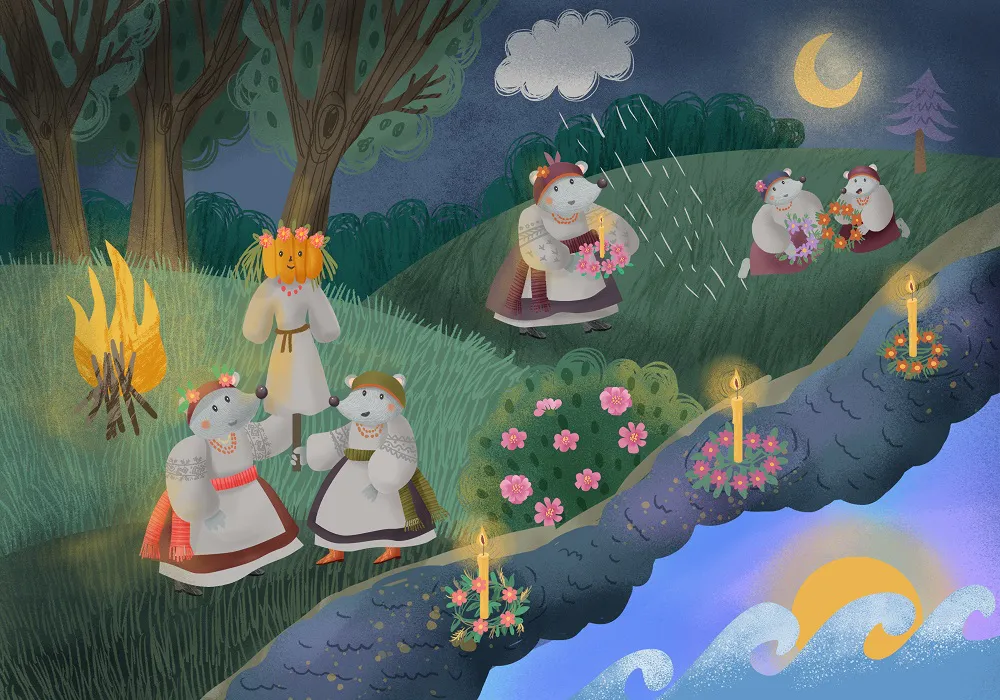
Our archive contains dozens of examples where Kupala songs were performed during rituals such as decorating trees, floating wreaths, jumping over bonfires, and the ceremonial “drowning” of effigy dolls. Young women danced in circles, performing lyrical songs with characteristic refrains like "Kupala na Yvana!" or similar appeals. Besides lyrical tunes, short, playful refrains with simple plots and light melodies also occur.
| Audio | Title | Genre | Location | Durat. | Lyrics | Notes |
|---|---|---|---|---|---|---|
| How to sow rye and over water | Midsummer (Kupala) | Klyushnykivka, Myrhorodskyi District | 02:08 |
Як посію рожу та над водою, Стороною дощик, та й стороною, Та й на мою рожу а червоную, Та й на мою м’яту кучерявую Шо у мене коса та й до пояса, | ||
| What if I plant a rose by the water | Midsummer (Kupala) | Klyushnykivka, Myrhorodskyi District | 03:34 |
Як посію рожу та й над водою, Стороною дощик та й стороною, Та й на мою рожу а червоную, Та й на мою м’яту кучерявую, Шо у мене коса та й до пояса, Як піду я до батенька попрошуся, Я й сам, доню, не піду, і тебе не пущу, Купався Йван, довелося й нам, Купалочка, де твоя дочка? Ой, льон, рубай льон, | ||
| По Купала я ходила | Midsummer (Kupala) | Yarmolyntsi, Romenskyi district | 00:32 |
По Купала я ходила, запащину я згубила, От попович ішов, запащину знайшов, Поповичу, сукин сину, оддай мені запащину. | ||
| Baked bread on Peter's Day | Midsummer (Kupala) | с. Братениця, Богодухівський район | 00:43 |
На Петра хліб пекла, на Йвана вибирала, Стояли коні на припоні, та попутані, та понуздані, Купався Денис, та й кладці завис, Купався Іван, та й у воду упав, Купався Петрусь, та й у воду плюсь, | ||
| Goes like a horse over buckwheat | Midsummer (Kupala) | Klyushnykivka, Myrhorodskyi District | 01:20 |
Ходить кониченько понад гречкою, Ой, постой же, коню, я осідлаю, Ой, чи вона жива та чи здорова, | ||
| Ivan bathed and joined us | Midsummer (Kupala) | Sharivka, Valkivskyi District | 00:57 |
Іван купавсь та й нам придавсь.
Цвіти рвали, віночки в’язали. Віночки в’язали, на воду кидали. На воду кидали, вогні зажигали. Вогні зажигали, з святом поздоровляли. | ||
| Whose flax is that | Midsummer (Kupala)
1
Information | Dobropillia, Valkivskyi District | 02:33 |
Ої чий же то льон та й заріс бур’яном, (Ой чи я ж то молода та не виполола?) То ж Маренчин же льон, що заріс бур’яном, | ||
| The widow had two daughters | Midsummer (Kupala)
1
Personal and Family Life | Kryachkivka, Pyriatynskyi District | 02:17 |
Було в вдови дві дочки, (двічі) Старша меньшу питає, (двічі) Старша меншій відмовля, (двічі) Ходьом, сестро, до броду, (двічі) Подивімось у воду, (двічі) Старша меншу попхнула, (двічі) Пливи, сестро, потопай, (двічі) | ||
| And Ivan bathed | Midsummer (Kupala) | Balakliia, Balakliiskyi District | 00:26 |
Та купався Іван Та купався Мусій, На калині роса впала, | ||
| Dill wheel | Midsummer (Kupala) | Polova, Derhachivskyi District | 00:15 |
Кроповоє колесо, |
Kupala songs were performed against a backdrop of vivid ritual actions. Every stage of the celebration was accompanied by singing. In Slobozhanshchyna, many varieties of festive trees and dolls have been documented, generally called "marinka," serving as key symbols of the festival. They were crafted from cherry branches, Tatar maple branches, grasses (thistle, reed, straw), clay, and clothing, decorated with ribbons, flowers, and berries. Special dishes prepared for the festival included scrambled eggs, young potatoes, bacon, and cherry "wine." Kupala was also a time to identify and neutralize witches by gathering the healing ashes from bonfires. Participants performed round dances, built bonfires, jumped over them and piles of nettles or thistles. The celebration concluded with the ritual "drowning" of the main symbol—a tree or doll—in a river, pond, or well, and setting wreaths afloat. At these moments, Kupala songs were sung with particular inspiration and belief in their magical power.
The magical significance of this festival has long since faded. Already by the 19th century, Kupala became largely recreational, gradually transitioning into a part of children's folklore.